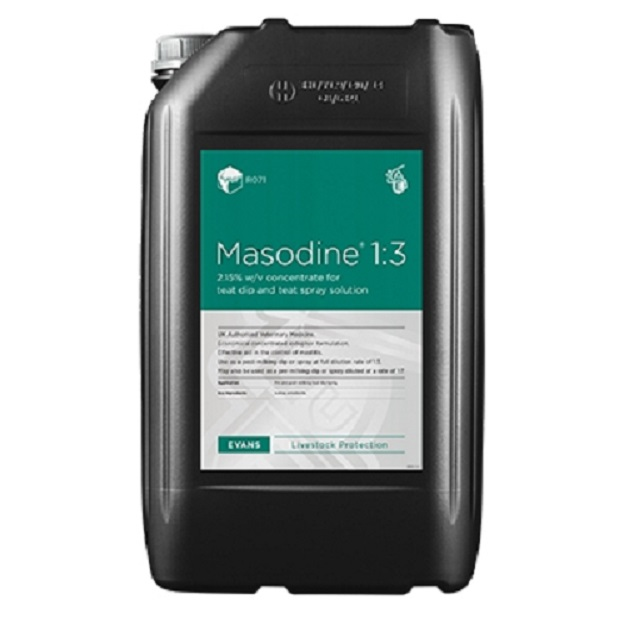
Evans Masodine Concentrate Teat Care
Evans Masodine Concentrate is an iodine-based teat dip, teat spray and udder wash solution for dairy milking routines. This listing supplies a 25 litre container of the 2.15% w/v concentrate. Measure the product into clean water before use, selecting the dilution for the particular stage of milking and application method.
The iodophor formulation helps reduce bacterial contamination associated with mastitis and leaves an antiseptic iodine film on teats treated after milking. Glycerine and sorbitol support soft, supple teat skin. The manufacturer specifies 20% combined emollients in the concentrate, giving 5% after the one-part-product to three-parts-water dilution used for post-milking dipping or spraying.
One concentrate can serve different labelled tasks, but the working solutions are not interchangeable. Post-milking use requires 1:3, pre-milking use requires 1:7, and udder washing or cluster dipping uses 1:500. Farms comparing a dedicated pre-milking option can also review Evans Pre-Dip and its own preparation instructions.
Consistent coverage, clean equipment and the specified wiping and drying procedure are central to the hygiene routine. For a different post-milking formulation, Masocare Extra is a ready-to-use alternative. Choose the product that fits the farm's programme and use its current container label alongside the related manufacturer documents.
Key Features & Benefits
- Concentrated iodophor formulation for pre- and post-milking teat hygiene.
- Suitable for dipping or spraying, with separate labelled dilutions for each milking stage.
- Helps reduce bacterial contamination and leaves an antiseptic iodine film after treatment.
- Glycerine and sorbitol emollients help maintain soft, supple teat skin.
- Manufacturer profile records EN 1656 bactericidal and EN 1657 yeasticidal testing under defined conditions.
- Additional manufacturer instructions cover udder washing and cluster dipping at 1:500.
- 25 litre pack for measured preparation of working solutions.
Directions for Use
Prepare the post-milking dip or spray
Mix one part concentrate with three parts clean water. For dipping, fill the cup about two-thirds full and immerse the full length of every teat immediately after each cow is milked. For spraying, cover the entire surface of each teat immediately after milking. Top up with fresh solution as required, then empty and wash the dipping cups when milking is complete.
Apply the pre-milking treatment
Mix one part concentrate with seven parts clean water. Ensure udders and teats are clean and dry first. Dip the full teat length using a cup filled about two-thirds full, or spray the entire teat surface. Allow 15 seconds of contact, then wipe and dry each teat thoroughly with a single-service paper towel before continuing the normal milking routine. Clean the application equipment after use.
Use the udder wash and cluster-dip dilution
Mix one part product with 500 parts clean water; the manufacturer gives 20 ml per 10 litres of water. Use individual cloths or disposable paper towels to help prevent cross-infection, and wash and dry udders and teats before milking. For cluster dipping, immerse the clusters and agitate for at least 30 seconds, then rinse in clean water before use.
Handle and store the concentrate correctly
Read the current label and safety data sheet before handling. The concentrate presents a risk of serious eye damage, so wear the specified eye protection and avoid splashes. Do not mix it with other chemicals. Keep the product in its original closed container, follow the stated storage conditions and keep it out of children's reach. Follow the label and safety data sheet for exposure response and disposal.
Product Specifications
| Specification |
Details |
| Manufacturer |
Evans Vanodine |
| Product |
Masodine Concentrate; R071 |
| Listed pack |
25 litres |
| Formulation |
2.15% w/v iodine-based concentrate |
| Appearance and odour |
Dark brown liquid with a faint iodine odour |
| Undiluted pH |
4.0, as stated on the product information sheet |
| Manufacturer shelf life |
2 years, subject to the specified storage conditions |
| Post-milking dilution |
1 part product to 3 parts clean water; minimum 5,000 ppm available iodine |
| Pre-milking dilution |
1 part product to 7 parts clean water; minimum 2,500 ppm available iodine; 15-second application contact time before wiping and drying |
| Udder wash and cluster dip |
1 part product to 500 parts clean water; minimum 40 ppm available iodine |
| EN 1656 post-milking example |
Staphylococcus aureus: 1:80, 5 minutes, 30°C, post-milking soiling conditions |
| EN 1656 pre-milking example |
Staphylococcus aureus: 1:40, 30 seconds, 30°C, pre-milking soiling conditions |
| EN 1657 examples |
Candida albicans: 1:80 at 30°C; 5 minutes with post-milking soiling or 30 seconds with pre-milking soiling |
| Test information |
Manufacturer microbiological profile, Edition 2, August 2026; laboratory conditions are separate from labelled application instructions |
FAQs
Is Masodine Concentrate ready to use?
No. This is the concentrated formulation and must be measured into clean water. The post-milking, pre-milking and udder-wash dilutions differ, so prepare the solution for the actual task instead of using one strength throughout the routine.
What pack is supplied by this listing?
The selectable pack is one 25 litre container. The manufacturer also describes other pack sizes in its literature, but those are not additional choices on this listing. Check the selected pack and displayed price when ordering.
How long should the pre-milking solution remain on teats?
The manufacturer product sheet specifies 15 seconds for the 1:7 pre-milking application. Afterwards, use a single-service paper towel to wipe and dry the teat thoroughly before milking. The longer times in the microbiological table describe laboratory tests at different dilutions.
Can the product be used for both dipping and spraying?
Yes, the manufacturer gives directions for both methods before and after milking. Use the correct stage-specific dilution and achieve full teat coverage. Keep cups and sprayers clean, and empty and wash dipping cups after the milking session.
What does the microbiological profile confirm?
It records bactericidal testing to EN 1656 and yeasticidal testing to EN 1657 against named organisms under specified conditions. The table above gives selected examples. Consult the complete profile for the full results and use the container label for practical application.
What role do the emollients play?
Glycerine and sorbitol help keep teat skin soft and supple within a consistent hygiene programme. Their presence does not change the preparation instructions: measure the concentrate accurately, apply as directed and complete the required pre-milking wiping and drying steps.