Evans FAM 30 Iodophor Disinfectant
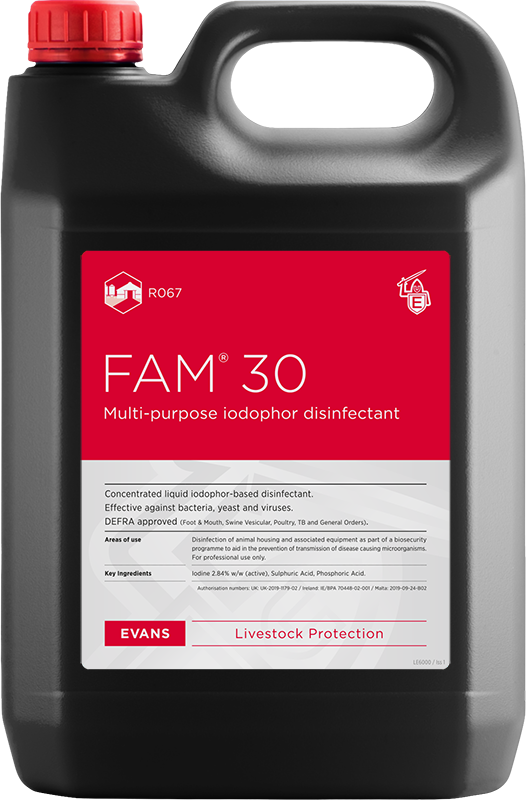
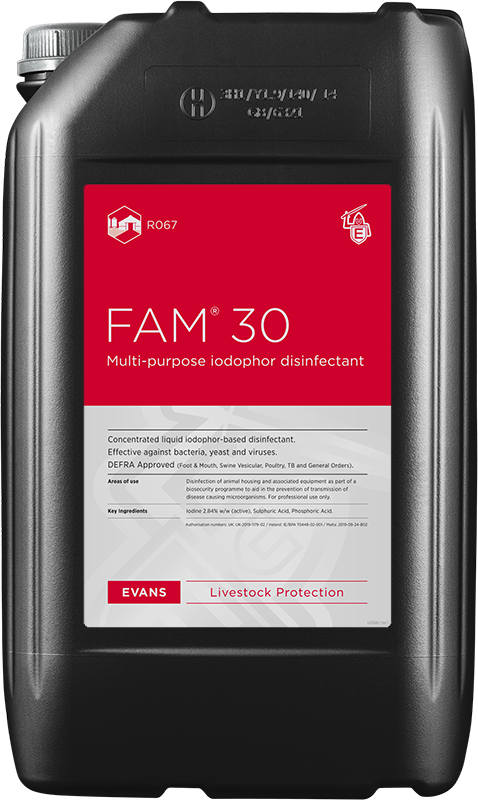
Evans FAM 30 is a concentrated iodophor disinfectant for livestock premises, agricultural surfaces and farm biosecurity routines. This listing offers a case of two 5 litre containers or one 25 litre container. Choose the pack required before ordering, then prepare the working solution for the specific labelled application.
The iodine-based formulation combines disinfection with surfactants that assist wetting and penetration. Evans documents activity against bacteria, fungi and viruses under defined test conditions, including work at low temperatures and with organic soiling. Those results support planned hygiene programmes; they do not remove the need to clear manure, litter and other heavy deposits before treatment.
FAM 30 can be used in appropriate surface-disinfection programmes and maintained boot dips or wheel baths. For the cleaning stage, Evans Shift provides a separate detergent option. Keep cleaning and disinfection instructions distinct, and select the concentration, application method and contact time for the surface and organism involved.
For buyers comparing livestock disinfectants, Omnicide is another formulation with its own use conditions. FAM 30's current manufacturer documents and disease-specific approvals should guide its selection. A routine boot-dip rate, an individual laboratory result and a statutory disease-control dilution serve different purposes and should not be interchanged.
Key Features & Benefits
- Concentrated iodine-based disinfectant for suitable livestock-premises and biosecurity applications.
- Manufacturer microbiological profile documents bactericidal, fungicidal and virucidal activity with organism-specific conditions.
- Surfactant-assisted wetting, with documented performance under specified organic-soiling and temperature conditions.
- Suitable for labelled boot-dip, wheel-bath and surface-disinfection routines.
- DEFRA approval covers Foot and Mouth, Swine Vesicular, Poultry, Tuberculosis and General Orders at their separate approved dilutions.
- Pack choices of 2 × 5 litres or 25 litres; supplied as concentrate for measured dilution.
Directions for Use
Prepare the area and equipment
Read the current container label and safety data sheet before starting. For livestock housing, remove portable equipment, litter and manure and clean away heavy soiling. Follow the site's requirements for removing animals and restricting access during treatment. Check surface compatibility and use suitable, clean application equipment.
Select the labelled routine-use dilution
Evans' general product sheet describes housing dilutions from one part FAM 30 to 100–550 parts water, selected for soil level and disease history. It specifies 1:100 for wheel and boot dips, with daily renewal. The same sheet states that UK and European uses and dilution rates must follow the specific biocidal-product label; the general range is not permission to use any strength for every job.
Match the treatment to the required approval
For statutory notifiable-disease control in Great Britain, the DEFRA listing checked on 14 October 2026 gives one part FAM 30 to the following parts water: Foot and Mouth 550; Swine Vesicular 100; Poultry and Avian Influenza 65; Tuberculosis 14; General Orders 49. Check the current listing and official instructions before use. Maintain the required contact time and complete all labelled rinsing, drying and re-entry steps; allow housing to dry where possible before equipment is replaced and animals return.
Handle the concentrate and store safely
FAM 30 concentrate can corrode metals, causes severe skin burns and eye damage, and is toxic to aquatic life with long-lasting effects. Wear the specified gloves, protective clothing and eye or face protection; avoid breathing mist. Never mix with bleach or other chemicals. Store locked up in the original closed container in a cool, ventilated place, away from alkalis and oxidising materials, and follow the disposal instructions.
Product Specifications
| Specification |
Details |
| Manufacturer |
Evans Vanodine |
| Product family |
FAM 30; R067 |
| Pack options |
2 × 5 litre case or 25 litre container |
| Product type |
Concentrated iodophor disinfectant |
| Appearance |
Dark brown liquid |
| Biocide authorisations |
GB-2019-1179-02; NI-2019-1179-02 |
| Manufacturer shelf life |
3 years, subject to the specified storage conditions |
| EN 1656 example |
Escherichia coli: 1:100, 30 minutes, 10°C, high soiling |
| EN 14349 example |
Staphylococcus aureus on stainless-steel carriers: 1:100, 30 minutes, 10°C, high soiling |
| EN 14675 example |
Bovine enterovirus: 1:100, 30 minutes, 10°C, low soiling |
| EN 1657 example |
Candida albicans: 1:50, 30 minutes, 10°C, high soiling |
| EN 14204 example |
Mycobacterium avium: 1:200, 5 minutes, 10°C, low soiling |
| EN 14348 example |
Mycobacterium terrae: 1:200, 60 minutes, 10°C and 20°C, clean conditions |
| EN 16437 example |
Staphylococcus aureus on wood carriers: 1:100, 240 minutes, 10°C, 3 g/l bovine albumin |
| Test information source |
Evans FAM 30 Microbiological Profile, Edition 16, July 2025; examples are laboratory conditions, not a universal application schedule |
FAQs
Is the 5 litre option sold individually?
No. The smaller option on this listing is a case containing two 5 litre containers. The other choice is one 25 litre container. Select the required pack to see its corresponding price before ordering.
Can FAM 30 be used undiluted?
It is supplied as a concentrate for measured dilution. Use the current label to select the strength for the permitted application, taking account of the surface, target organism and any official disease-control requirements.
How should boot-dip solutions be maintained?
The manufacturer product sheet gives a 1:100 dilution and daily renewal for wheel and boot dips. Follow the current label and site procedure, remove heavy soil before disinfection, and use the applicable approved strength when statutory disease control requires it.
Is 1:100 the approved rate for every disease?
No. The current DEFRA rates differ between disease orders. For example, the checked listing gives 1:65 for Poultry and Avian Influenza and 1:14 for Tuberculosis. Use the exact current approval and official directions relevant to the situation.
What do the EN test results show?
They show performance against particular organisms under stated laboratory conditions. Suspension tests and surface tests use different methods. The specifications give selected examples; consult the full current microbiological profile for the complete results and follow the label for practical application.
Does activity in organic matter mean cleaning can be skipped?
No. Evans' housing directions still require removal of litter, manure and heavy soiling before disinfection. Clean first, apply the correctly prepared solution and complete the required treatment. Use biocides safely and always read the label and product information before use.