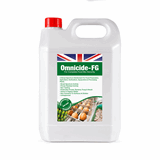
Omnicide Livestock Disinfectant 5L
Omnicide is a concentrated disinfectant from Mirius for animal housing, farm surfaces and compatible equipment. Supplied in a 5 litre container, it combines glutaraldehyde with a quaternary ammonium compound for use within a planned livestock hygiene programme. It gives poultry and livestock teams a single product to assess against their site's different disinfection tasks, with the correct preparation and dilution for each application.
Successful disinfection begins with an organised cleaning stage. Removing animals, clearing organic material and washing down the building allows the disinfectant to reach the surfaces being treated. Omnicide fits into this sequence after cleaning, so it can be included in turnaround plans alongside separately selected detergents, cleaning equipment and protective clothing. Plan sufficient time for the full process before returning the building to service.
The manufacturer's testing covers bacterial, viral and fungal targets, with specific concentrations, temperatures and exposure times. Its DEFRA approvals also have distinct rates for different disease orders. These details help buyers select the right disinfectants for a documented site procedure, while avoiding the assumption that one dilution applies to every organism, surface or legal requirement.
The 5 litre format suits teams that measure concentrate into application equipment or prepare smaller batches for scheduled work. Check the required solution volume against the area and method before mixing, and keep preparation instructions accessible to trained staff. Omnicide is a professional chemical product: review the supplied label, current safety sheet and application guidance when planning storage, protective equipment and access to treated areas.
Key Features & Benefits
- 5 litre disinfectant concentrate for poultry and livestock premises and compatible equipment.
- Glutaraldehyde and quaternary ammonium formulation.
- Manufacturer-documented bactericidal, virucidal and fungicidal testing, with conditions shown below.
- DEFRA approval for Foot and Mouth, Swine Vesicular Disease, Diseases of Poultry and General Orders at their respective rates.
- Suitable for inclusion in a staged cleaning and disinfection programme.
- Concentrated format allows solution preparation to match the planned task.
Directions for Use
Prepare and clean the area
Remove birds or livestock and clear organic material. Clean surfaces with a suitable detergent, such as Omniclean, using its own directions. Rinse away loosened soil and detergent and allow surfaces to dry before disinfection. Organise work so cleaned equipment and areas are not recontaminated by dirty tools or footwear.
Select the correct dilution
For statutory use in Great Britain, the listed DEFRA rates are one part product plus 60 parts water for Foot and Mouth Disease Orders, 100 for Swine Vesicular Disease Orders, 90 for Diseases of Poultry and Avian Influenza Orders, and 45 for General Orders. Omnicide is not listed as approved for Tuberculosis Orders. Check the current approval and label before each disease-control programme. Laboratory test dilutions in the specification table do not replace these statutory rates.
Apply and allow the required exposure
The manufacturer gives 1:100–1:200 for routine treatment of precleaned walls, floors and equipment, selected for the pathogen challenge. Apply at low pressure; a compatible foaming lance can help show coverage. Use the contact time required for the chosen application and keep surfaces treated for the full period. Rinse feed-contact surfaces before allowing them to dry. Follow the label and site procedure for drying and re-entry.
Handle and store the concentrate safely
Wear suitable chemical-resistant gloves, protective clothing and eye/face protection, with respiratory protection where required by the safety sheet and risk assessment. Avoid breathing vapour or spray and work with effective ventilation. The concentrate is corrosive, toxic if inhaled and harmful if swallowed, and may cause skin or respiratory sensitisation. Prevent environmental release. Keep the original container securely closed in a ventilated, locked chemical store and follow the safety sheet for spills and disposal. Use biocides safely. Always read the label and product information before use.
Product Specifications
| Specification |
Details |
| Product |
Omnicide |
| Manufacturer |
Mirius / Coventry Chemicals Limited |
| Pack supplied |
1 × 5 litres |
| Format |
Liquid disinfectant concentrate |
| Active substances, per SDS |
Glutaraldehyde 15g/100g; alkyl (C12–18) dimethylbenzyl ammonium chloride 10g/100g |
| EN 14476:2013 + A2:2019 |
Vaccinia: 0.1%, 5 minutes, 20°C, clean conditions |
| EN 14476:2013 + A2:2019 |
H1N1 influenza A: 0.25%, 5 minutes, 20°C, clean conditions |
| EN 1276:2009 |
Bacterial panel: 0.1%, 5 minutes, 20°C, clean conditions |
| EN 1656:2019 |
Bacterial panel: 0.5%, 30 minutes, 20°C, low soil |
| EN 1657:2016 |
Candida albicans: 0.5%, 30 minutes, 20°C, low soil |
| EN 14675:2015 |
Bovine enterovirus type 1: 1%, 30 minutes, 10°C, clean conditions |
| EN 14675:2015 |
Newcastle disease virus: 0.25%; Gumboro disease virus: 0.5%; Swine Vesicular Disease virus: 1%; Foot and Mouth Disease virus: 1.25%. Each tested for 30 minutes at 10°C, low soil |
| Test interpretation |
Results apply to the stated organisms and test conditions; use the label and applicable statutory rate for the intended task |
FAQs
What pack size am I ordering?
This listing supplies one 5 litre container of Omnicide concentrate. The amount of prepared solution depends on the selected dilution and application. Calculate the quantity needed for your planned work before ordering, allowing for the surfaces and equipment that must be treated.
Is Omnicide ready to use?
No. It is a concentrate that must be measured and diluted for the task. Prepare it with suitable measuring and application equipment, following the current label. Keep dilution instructions with the work procedure so different staff do not inadvertently use different strengths for the same job.
Can one rate cover every disease order?
No. The statutory rates differ, and a routine cleaning programme or laboratory test result is not a substitute for the applicable disease order. Identify the relevant requirement before treatment, then check the product's current approval and instructions. Use the stated product-to-water ratio accurately.
What do the EN test results tell me?
They describe performance against the listed test organisms under defined conditions. Concentration, exposure time, temperature and soil level all matter. A result for one virus or bacterial panel should not be presented as proof of effectiveness against every pathogen or as permission to shorten an application time.
Do surfaces need cleaning first?
Yes. Make removal of soil and organic material part of the preparation stage, then clean, rinse and dry as directed before applying Omnicide. Disinfection is a separate stage in the programme. Keep cleaned equipment away from contaminated surfaces and avoid bringing dirty tools back into a finished area.
How should I plan for safe use on site?
Review the label and safety sheet with the staff responsible for chemical handling and the site's risk assessment. Provide suitable protective equipment, ventilation, measuring tools and secure storage. Plan access restrictions and re-entry around the application instructions; specialist methods such as fogging require specific manufacturer guidance and trained operators.