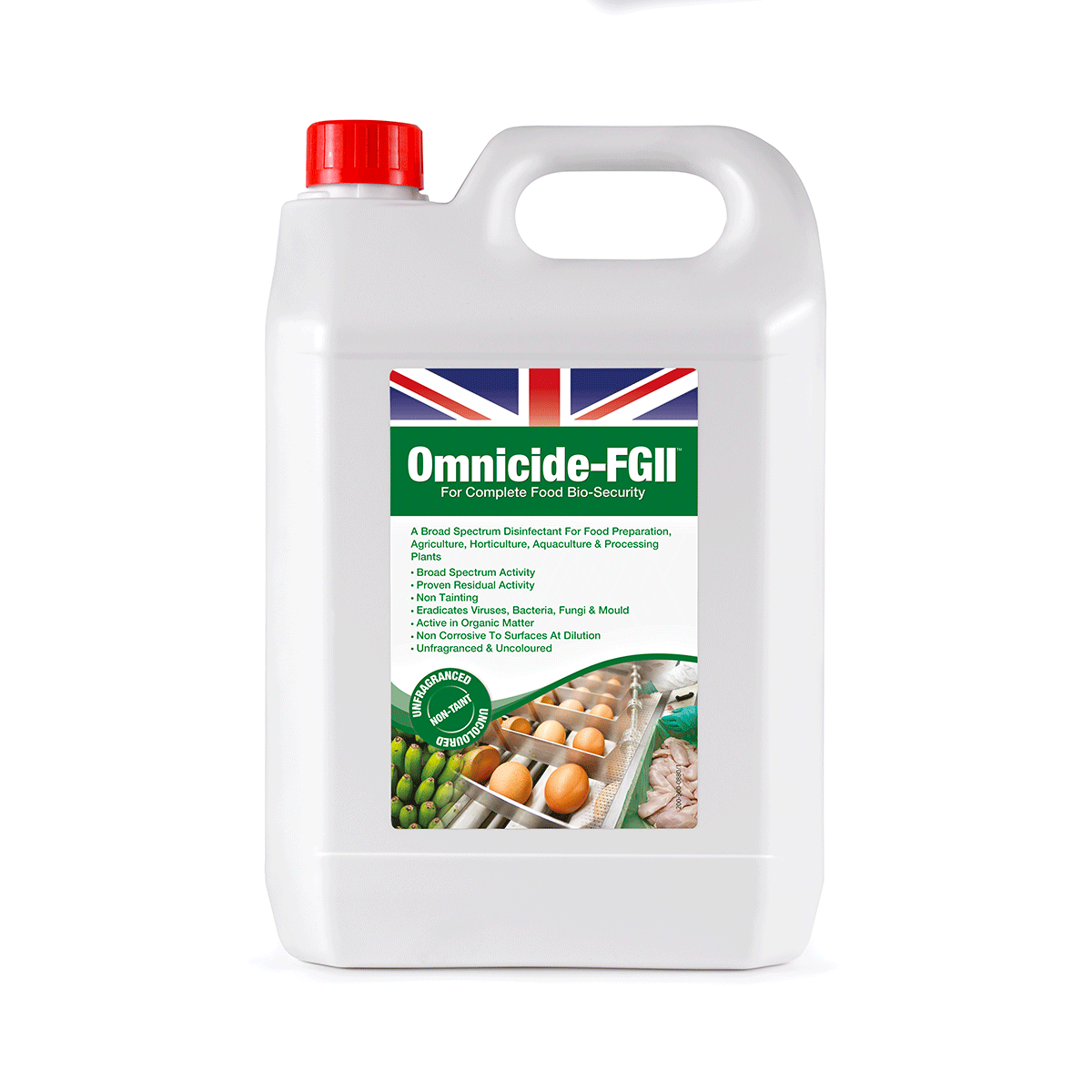
Omnicide FGII Disinfectant Concentrate 25L
Omnicide FGII gives food-production teams a disinfectant concentrate without added dye or perfume. The colourless formulation is intended for professional surface disinfection in food-preparation environments, including slaughterhouses, where product selection forms part of an established hygiene programme.
This 25 litre supply format supports premises that prepare measured working solutions for regular disinfection tasks. FGII contains glutaraldehyde and a quaternary ammonium compound, with the concentration, application method and contact period selected from the product label for the surface and process involved.
The absence of added colour distinguishes FGII from Omnicide FG, the unfragranced amber variant. Using the full product name when ordering, storing and dispensing helps staff select the correct formulation and its accompanying safety information.
Build FGII into a complete cleaning and disinfection routine. A suitable detergent such as Omniclean removes soil during the first stage; the disinfectant is then used under its own instructions. Prepare surfaces properly and complete the required contact period and rinse before equipment returns to service.
Key Features & Benefits
- No added dye or perfume: the colourless, unfragranced FGII formulation.
- Food-production surface disinfection: intended for appropriate professional food-preparation and slaughterhouse applications.
- Concentrate for measured preparation: working strength is selected for the intended task.
- Glutaraldehyde and QAC active substances: identified in the formulation-specific safety data sheet.
- 25 litre supply: supports regular site hygiene programmes with controlled dispensing.
- Defined DEFRA listings: approved for the specified disease orders at their individual dilutions.
Directions for Use
Confirm the formulation and prepare surfaces
Check that the container is Omnicide FGII and read its label and safety data sheet. Follow the site's procedure for preparing the area, food and equipment. Remove loose contamination, carry out the appropriate detergent clean and finish the cleaning-stage rinse before beginning disinfection.
Measure the application-specific solution
For normal food-area work, use the dilution, method and contact time stated on the FGII label for that application. For statutory animal-disease-control uses requiring DEFRA approval, the current FGII entry specifies one part product to 60 parts water for Foot and Mouth Disease Orders, 100 parts water for Swine Vesicular Disease Orders, 90 parts water for the poultry and avian-influenza orders, and 45 parts water for General Orders. FGII is not approved for Tuberculosis Orders. These entries do not define a general food-contact cleaning procedure.
Apply under the required handling conditions
Use only the application method specified for the task and provide the required ventilation. Do not breathe vapour or spray. The concentrate is toxic if inhaled and causes severe skin burns and eye damage; wear the protective gloves, clothing, eye and face protection specified in the safety data sheet and workplace assessment.
Finish the treatment and store the concentrate
Allow the full label contact period, then complete any required rinse before returning the surface or equipment to use. Pay particular attention to food-contact requirements. Avoid environmental release. Keep the original container tightly closed in a cool, dry, well-ventilated place away from food and drink, following the storage instructions in the safety data sheet.
Product Specifications
| Specification |
Details |
| Product |
Omnicide FGII |
| Manufacturer |
Mirius / Coventry Chemicals Ltd |
| Container size |
25 litres |
| Manufacturer product number |
500-200-0630 |
| Product type |
Professional disinfectant concentrate |
| Appearance |
Clear, colourless liquid |
| Added dye / perfume |
None |
| Active substances |
Glutaraldehyde 15.0 g/100 g; alkyl (C12–18) dimethylbenzyl ammonium chloride 10.0 g/100 g |
| DEFRA Foot and Mouth Disease Orders |
1 part product to 60 parts water |
| DEFRA Swine Vesicular Disease Orders |
1 part product to 100 parts water |
| DEFRA poultry / avian-influenza orders |
1 part product to 90 parts water |
| DEFRA General Orders |
1 part product to 45 parts water |
| DEFRA Tuberculosis Orders |
Not approved |
| Routine application instructions |
Use the FGII label's task-specific dilution, contact time and rinse |
FAQs
What makes FGII the colourless option?
FGII is formulated without added dye or perfume, and its safety data sheet describes a clear, colourless, unperfumed liquid. This distinguishes it from the amber FG variant while keeping the product identity clear for purchasing and handling.
Where is this formulation intended to be used?
The manufacturer identifies food-production and food-preparation areas, including slaughterhouses. Suitability still depends on the particular surface and process. Use the FGII label and the site's hygiene procedure to select the application and complete any required rinsing.
Is the 25 litre product ready to use?
No. This is a concentrate for measured dilution. Prepare the working solution at the strength specified for the application, and follow the corresponding contact time and finishing instructions. The larger container does not change the product's handling requirements.
Which DEFRA approvals apply to FGII?
The current FGII listing covers Foot and Mouth Disease, Swine Vesicular Disease, the poultry and avian-influenza orders, and General Orders at the individual dilutions shown above. It does not include approval under Tuberculosis Orders. Check the applicable listing when statutory approval is needed.
Does a dye-free, perfume-free formula need protective equipment?
Yes. The concentrate still has corrosive, inhalation and sensitisation hazards. Follow the FGII safety data sheet for ventilation, protective clothing, gloves and eye/face protection, and use the workplace handling procedure when dispensing or applying it.
How does FGII fit into the cleaning programme?
Use it after the appropriate detergent cleaning and rinsing stage. Disinfection then requires the product-specific concentration, application and contact period, followed by any stated rinse. Keep these stages distinct so that removing soil and disinfecting surfaces each receive the required treatment.