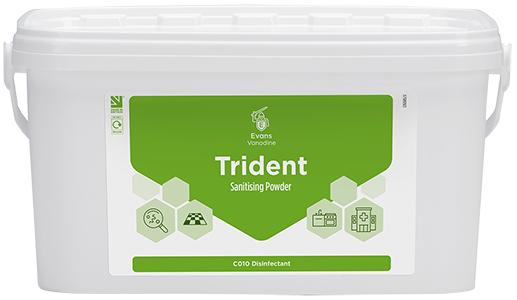
C010 - Trident Sanitising Powder 5kg
Evans Trident combines cleaning detergents with chlorine-releasing agents in a versatile powder format. The 5kg bucket provides a practical supply for catering, housekeeping and dairy cleaning routines where staff need to prepare the product for different jobs. Its applications include compatible food-preparation surfaces, kitchen equipment, vending-machine parts and washable cleaning cloths.
The powder can be used directly or dissolved to make a working solution, but the preparation matters. Evans gives separate instructions for each application, with different chlorine concentrations for neat use, equipment cleaning and lower-strength soaking tasks. This helps teams choose a measured method for the job instead of assuming that one dilution will suit every surface or item.
Trident also has specific guidance for manual cleaning of stainless-steel bulk milk tanks. Working the powder into a paste on the wet tank surface allows the cleaner to be brushed over the areas identified in the manufacturer's procedure. The subsequent waiting and rinsing stages are part of that method and should be included in the cleaning routine.
The bucket format is convenient for a workplace with repeated cleaning requirements and a controlled chemical store. For other dairy applications, view Evans Metron or Evans Hypochlorite. Select each chemical for its specified purpose and use it separately according to its own label and safety information.
Key Features & Benefits
- Detergent and chlorine-releasing powder: supports the manufacturer's specified cleaning and sanitising applications.
- 5kg bucket: provides stock for measured preparation during regular cleaning routines.
- Several preparation methods: neat use, diluted solutions and a bulk-tank paste method address different tasks.
- Kitchen and dairy applications: guidance covers compatible equipment, floors and walls.
- Stain-removal tasks: includes tannin removal from crockery and treatment of washable cloths.
- Documented concentrations: distinct instructions help staff match the solution to the application.
Directions for Use
1. Prepare safely and treat suitable surfaces
Read the label and current Safety Data Sheet. Wear the specified eye or face protection, gloves and protective clothing, and avoid breathing dust. When making a solution, carefully add the powder to water; never pour water onto the product. Keep it separate from acids, which can release toxic gas. For the direct surface-cleaning method, sprinkle powder onto a damp cloth or sponge, wipe until clean, rinse with clean water and leave to air dry.
2. Prepare the equipment-cleaning solution
For kitchen and dairy equipment, floors and walls, prepare a 4% solution using 40g per litre of warm water. Immerse suitable washable equipment or wipe the solution onto the equipment as directed, then rinse with clean water and allow to air dry. Evans identifies this solution as providing 1,000ppm available chlorine; do not apply the neat-product chlorine figure to it.
3. Clean vending-machine parts or soak crockery and cloths
Prepare a 1% solution using 10g per litre of warm water. For vending machines, immerse removable parts or wipe the solution onto appropriate parts, then rinse with clean water and air dry. For tannin removal or cloth treatment, immerse the crockery or cloths for up to 30 minutes, rinse thoroughly and air dry. The stated available chlorine at this dilution is 250ppm.
4. Hand-clean a stainless-steel bulk milk tank
After emptying the tank, rinse with clean cold water. Sprinkle Trident onto the wet surfaces and work it into a paste with a soft tank brush. Brush over the surfaces, including the paddle, bridge, underside of lids and outlet; clean the removable dipstick and outlet cap. Wait five minutes after brushing, then rinse thoroughly with clean cold water and refit the cleaned parts as directed.
Product Specifications
| Product |
Evans Trident sanitising powder |
| Astral product code |
C010 |
| Manufacturer 5kg code |
C010AEV |
| Pack size |
5kg bucket |
| Appearance |
Blue powder |
| Odour |
Faint chlorine |
| Equipment-cleaning solution |
40g/litre warm water; 4%; 1,000ppm available chlorine |
| Vending and soaking solution |
10g/litre warm water; 1%; 250ppm available chlorine |
| Direct-use chlorine information |
Manufacturer states over 10,000ppm for the specified neat/paste applications |
| Key hazards |
Serious eye damage; toxic to aquatic life with long-lasting effects; contact with acids releases toxic gas |
FAQs
What is the 5kg Trident powder used for?
It combines detergent with chlorine-releasing agents for the manufacturer's specified cleaning and sanitising tasks. These include compatible kitchen and dairy equipment, food-preparation surfaces, vending-machine parts and soaking applications. Choose the preparation method for the task and follow the required rinsing stage.
Does every Trident solution contain over 10,000ppm chlorine?
No. The manufacturer associates that figure with the specified direct powder or paste applications. Its 4% solution is stated as 1,000ppm, while the 1% solution is 250ppm. Measure the powder and water accurately and use the concentration appropriate to the job.
Which dilution is used for kitchen or dairy equipment?
Evans specifies 40g per litre of warm water, making a 4% solution. Treat compatible washable equipment by the stated immersion or wiping method, then rinse with clean water and allow to air dry. Check equipment compatibility and the container label before starting.
How long should crockery or cloths soak?
For tannin removal and cloth treatment, the manufacturer specifies 10g per litre of warm water and immersion for up to 30 minutes. Rinse thoroughly afterwards and allow to air dry. This soaking time is not a general contact time for every Trident application.
Can Trident be mixed with other cleaning chemicals?
Keep it separate from other chemicals and follow its own preparation instructions. Contact with acids releases toxic gas. When diluting, add the powder carefully to water, never water directly to the powder, and follow the protective measures in the SDS.
How should the bucket be stored?
Keep the product in its original, tightly closed container in a cool, dry, well-ventilated place, protected from sunlight and away from acids. Keep it out of children's reach and consult the attached SDS for full handling, storage and disposal information.