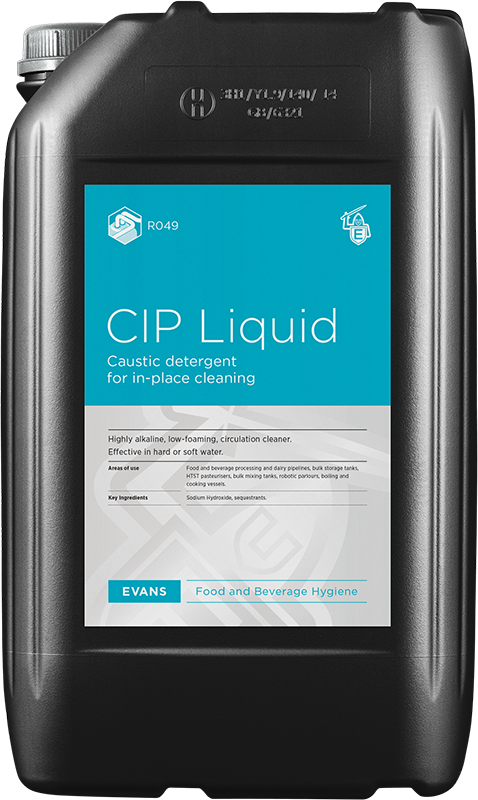
CIP Liquid-25LTR
Evans CIP Liquid is a concentrated alkaline detergent for cleaning compatible food-processing plant without dismantling every part of the system. The chlorine-free formulation tackles fats, oils and protein deposits in circulation cleaning. This listing supplies the 25-litre R049KEV container for professional dairy and food-production cleaning programmes.
Typical applications include dairy pipelines, bulk storage and mixing tanks, HTST pasteurisers and suitable conventional or robotic milking systems. The low-foam cleaner can form part of single-stage or multi-stage processes. Select it from our dairy hygiene chemicals according to the equipment manufacturer’s requirements and the type of residues being removed.
The formulation contains sequestrant and suspending ingredients to help control calcium deposits in tanks and pipelines across different water conditions. Cleaning performance also depends on the concentration, temperature, circulation time and condition of the equipment. Use the application-specific method, monitor the programme and complete the required clean-water rinsing stage before returning equipment to service.
CIP Liquid is highly caustic and requires trained handling, suitable protective equipment and careful checks of material compatibility. Keep it away from aluminium and other soft metals. If a separate acid-cleaning stage is required, assess a product such as Evans Acid Brite under its own instructions; never mix acid cleaner with CIP Liquid.
Key Features & Benefits
- Alkaline circulation cleaning: removes fats, oils and protein deposits from compatible processing equipment.
- Chlorine-free formulation: an option for approved cleaning programmes that specify a non-chlorinated alkaline detergent.
- Low foam: designed for circulation through suitable pipelines, tanks and closed plant.
- Water-condition support: sequestrant and suspending ingredients help limit calcium accumulation.
- Several defined methods: manufacturer directions distinguish standard CIP, pasteuriser and soak-cleaning applications.
- 25L container: product code R049KEV identifies the pack supplied on this listing.
Directions for Use
1. Confirm suitability and prepare safely
Read the product label, current safety sheet and equipment instructions. CIP Liquid causes severe skin burns and eye damage: wear the specified chemical-resistant gloves, protective clothing and eye/face protection, and avoid breathing mist. Do not use on aluminium or other soft metals. Pre-rinse pipelines or plant with clean water and drain before treatment.
2. Follow the standard CIP method
For standard CIP systems, the manufacturer specifies a concentration of 1–1.2% v/v according to soiling, heated to 75–90°C. Circulate for up to 15 minutes, then run to waste in accordance with the site procedure. Confirm that the selected concentration and temperature are appropriate for the installation before starting the cycle.
3. Use the correct alternative application
For pasteuriser systems, use 1.8% v/v at 75°C after the pre-rinse, circulate for up to 20 minutes, then run to waste. For manual or soak cleaning, first remove as much soiling as possible, then use 1–5% v/v at 50°C according to soiling, ensuring equipment surfaces are submerged. These are separate methods, not interchangeable settings.
4. Rinse thoroughly and complete the programme
After cleaning, rinse all equipment and surfaces thoroughly with clean water. Carry out any separately specified disinfection stage using its own product directions and approved site procedure. Do not mix chemicals or omit rinsing between incompatible stages. Keep CIP Liquid closed in its original container in a cool, ventilated store, away from acids and oxidising materials.
Product Specifications
| Product |
Evans CIP Liquid |
| Manufacturer |
Evans Vanodine |
| 25L order code |
R049KEV |
| Container size |
25 litres |
| Type |
Concentrated, chlorine-free alkaline circulation detergent |
| Appearance |
Colourless liquid |
| Standard CIP method |
1–1.2% v/v; 75–90°C; circulate for up to 15 minutes |
| Pasteuriser method |
1.8% v/v; 75°C; circulate for up to 20 minutes |
| Manual/soak method |
1–5% v/v; 50°C; immerse compatible equipment |
| Rinsing |
Thorough clean-water rinse after cleaning |
| Material exclusions |
Aluminium and other soft metals |
| Key handling hazard |
Causes severe skin burns and eye damage |
FAQs
What is CIP Liquid designed to clean?
It is a caustic detergent for compatible food-processing and dairy equipment, including pipelines, bulk tanks and pasteurisers. It targets fats, oils, proteins and other specified processing residues. The equipment manufacturer’s cleaning requirements should determine whether this alkaline product is suitable for a particular installation.
What concentration should I use for ordinary CIP circulation?
The current Evans information sheet specifies 1–1.2% v/v, selected according to the soiling level, at 75–90°C for up to 15 minutes. Pre-rinse and drain first, then follow the cleaning cycle with thorough clean-water rinsing. Pasteurisers have a separate method and should not automatically use these settings.
Does the pasteuriser method use the same dose?
No. The manufacturer specifies 1.8% v/v at 75°C, circulated for up to 20 minutes after a pre-rinse. Follow the plant’s approved cleaning procedure and material limits. Use the current product sheet for the complete sequence and rinse equipment thoroughly with clean water after cleaning.
Can CIP Liquid be used on aluminium parts?
No. Evans excludes aluminium and other soft metals from suitable applications. Check every component in the circuit or soak tank, including fittings and removable parts, before use. Where the material is uncertain, obtain equipment-specific advice rather than assuming that a food-processing application makes it compatible.
Is this a disinfectant as well as a detergent?
CIP Liquid is supplied as an alkaline cleaning detergent. Where the hygiene programme requires disinfection, use the separately specified disinfectant after cleaning and rinsing, following that product’s directions. Do not infer a disinfection claim from the detergent’s strong alkalinity or mix it with another chemical.
What precautions are needed when handling the concentrate?
The concentrate is corrosive and can cause severe skin burns and eye damage. Follow the safety sheet, wear the specified gloves, clothing and eye/face protection, and avoid mist exposure. Keep it in its labelled original container, store separately from acids and follow the site’s trained chemical-handling procedure.