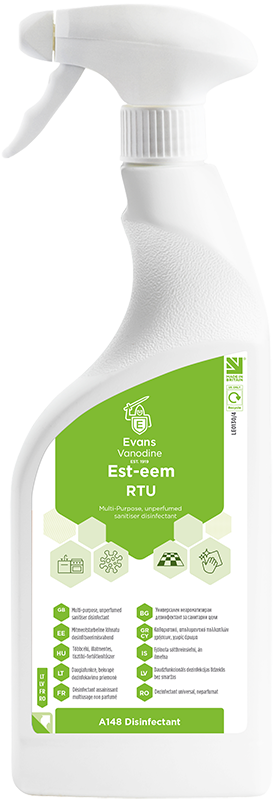
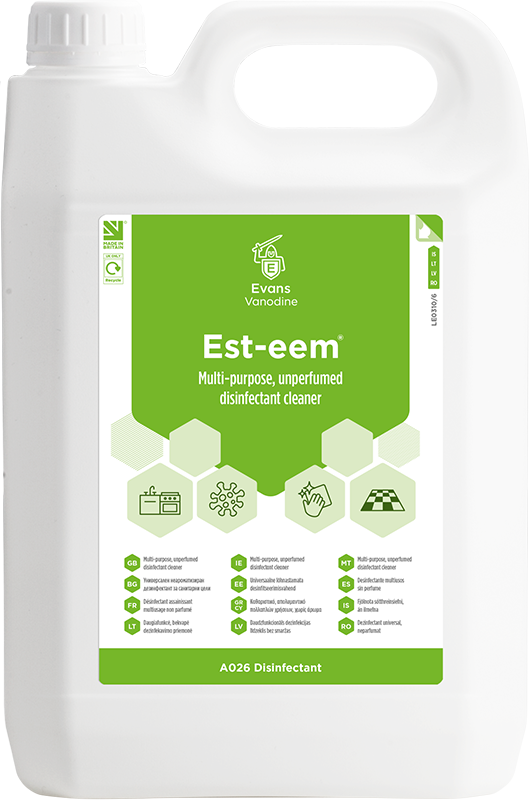
Evans Est-eem Cleaner Sanitiser
Evans Est-eem Cleaner Sanitiser combines BS EN 1276 bactericidal performance with unperfumed cleaning for commercial kitchens and food-preparation areas.
BS EN 1276 and complementary hygiene tests
Evans documents BS EN 1276 bacterial performance, BS EN 1650 yeast testing and BS EN 16615 wiping tests. EN 14476 and EN 16777 separately address enveloped-virus performance in suspension and on non-porous surfaces. The technical information retains each format’s individual treatment conditions.
Unperfumed cleaning across food premises
Est-eem cleans washable worktops, kitchen equipment, floors and walls without a strong perfume. The RTU spray provides prepared treatment, while the concentrate supports measured working solutions for wider cleaning routines.
Key Features & Benefits
- BS EN 1276 bactericidal cleaner sanitiser.
- Unperfumed formula for food-area cleaning.
- BS EN 1650 yeast and BS EN 16615 wiping tests.
- BS EN 14476 and BS EN 16777 enveloped-virus testing.
- Ready-to-use and concentrated formats.
- Applications across worktops, equipment, floors and walls.
Technical Specifications
| Specification or test |
Details |
| Manufacturer |
Evans Vanodine |
| Formats offered |
750ml ready-to-use spray; 5-litre concentrate |
| Product codes |
A148 ready-to-use; A026 concentrate |
| Appearance and fragrance |
Clear colourless liquid; unperfumed |
| BS EN 1276 — bacterial application |
Concentrate 1:25; RTU undiluted: 30 seconds |
| BS EN 1650 — yeast application |
Concentrate 1:25; RTU undiluted: 1 minute |
| BS EN 16615 — modified bacterial / yeast wiping application |
Concentrate 1:25; RTU undiluted: 1 minute; use the wiping method |
| BS EN 16777 — enveloped-virus surface application |
Concentrate 1:25 recommended for combined bacterial treatment; RTU undiluted: 1 minute |
| BS EN 14476 — enveloped-virus suspension test |
Concentrate 1:15 at 20°C in clean conditions: 5 minutes, per July 2026 profile |
| General cleaning without disinfection |
Concentrate 1:50; 100ml in 5 litres of final solution |
| Food-contact surfaces |
Rinse with clean water after treatment |
Ideal Applications
- Restaurant and café preparation areas.
- Hotel and canteen kitchens.
- Washable food-contact worktops and equipment.
- Commercial kitchen floors and walls.
Directions for Use
Prepare the selected format
Use the 750ml ready-to-use spray undiluted. For the concentrate’s recommended 1:25 surface-disinfection solution, add 30ml and make up to 750ml with clean water. Label working bottles and follow the current container instructions.
Clean, then disinfect
Remove food debris and clean the surface first. Apply with a spray, clean cloth or mop. Allow 30 seconds for the specified bacterial application or 1 minute for the listed yeast, wiping and enveloped-virus surface applications. Keep surfaces wet throughout contact.
Use the correct virus-test conditions
For the concentrate’s documented BS EN 14476 suspension claim, the July 2026 profile specifies 1:15 and 5 minutes in clean conditions at 20°C. The BS EN 16777 surface application has different conditions; select the method required by your cleaning procedure and current label.
Wipe, rinse and dry
Wipe with a clean cloth and allow to dry. Rinse food-contact surfaces with clean water before drying. For general cleaning without a disinfection claim, dilute the concentrate 1:50: 100ml in 5 litres of final solution.
FAQs
Does Est-eem meet BS EN 1276?
Yes. Evans documents BS EN 1276 bactericidal performance for Est-eem, alongside its other hygiene test results.
What is the bacterial contact time?
The recommended 1:25 concentrate solution and undiluted RTU application use a 30-second bacterial contact time.
Which virus tests are documented?
EN 14476 addresses enveloped-virus activity in suspension, while EN 16777 addresses non-porous surfaces. Their individual concentrations and contact times are retained in the technical table.
Is Est-eem perfumed?
No. Its unperfumed formula is designed for food-area cleaning and sanitising.
How do the two formats differ?
RTU is supplied at working strength. Concentrate is diluted for the specified cleaning or disinfection application.
Do food-contact surfaces need rinsing?
Yes. Rinse with clean water after the required treatment, then allow the surface to dry.