TASKI Robotics & Robotic Cleaning Machines
No products match your filters
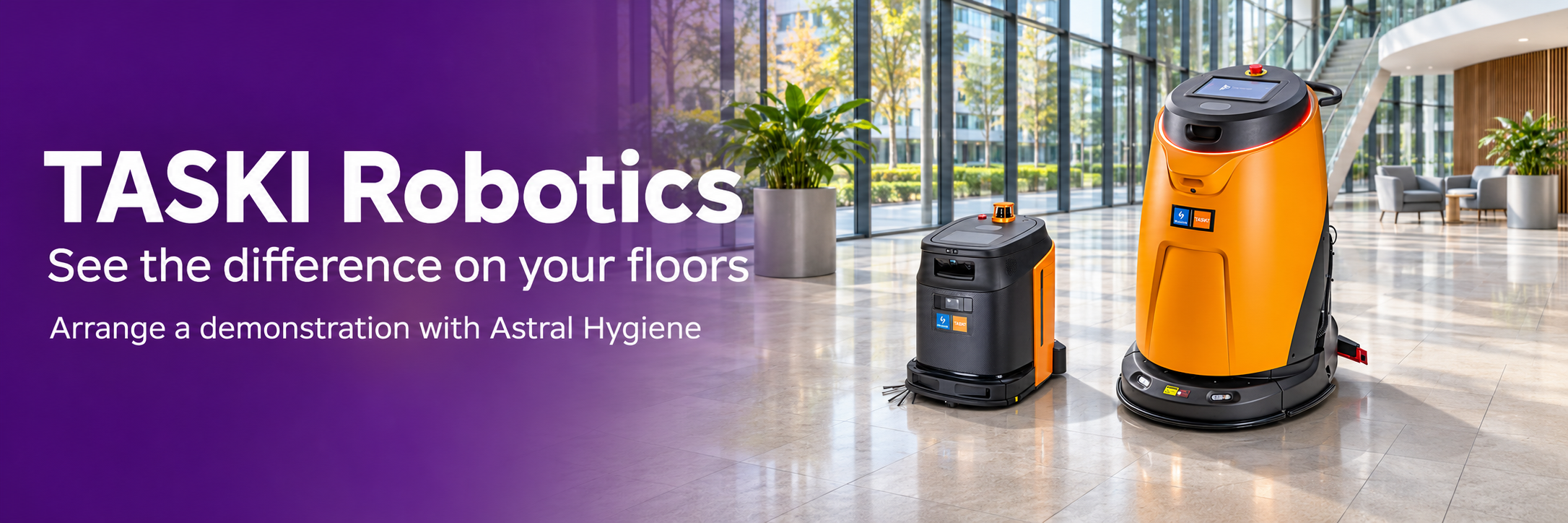
Explore TASKI robotic cleaning machines with Astral Hygiene. From compact robots for furnished rooms to autonomous scrubber dryers and industrial sweepers, the TASKI range gives cleaning teams new ways to manage repetitive floorcare. Compare PHANTAS, PHANTAS 1.4 EXTRA, ECOBOT 50 Pro and BEETLE 2.0 below, with additional information on ECOBOT 40. We welcome enquiries from NHS organisations, local councils and other local authorities, educational facilities and retail stores across the UK.
TASKI robotics are supplied through a demonstration and quotation with Astral Hygiene. Tell us about your building and we will discuss a suitable machine and arrange the next step with a TASKI specialist. A demonstration lets you assess the cleaning result, access and daily routine before choosing a package.
Arrange a TASKI robotics demonstration Call 01835 824342
Explore: Compare the range | Machine details | Your demonstration | Brochures and data sheets | FAQs
Autonomous floor cleaning that supports your team
A long corridor still needs cleaning when staff are busy with washrooms, touchpoints or unexpected spillages. TASKI robots can take on planned floor routes, allowing people to concentrate on work that needs their judgement and attention. Once the machine has been set up for the site, mapped routes and scheduled tasks help make routine cleaning repeatable.
The TASKI robotics range, powered by Gausium technology, covers different jobs. A robotic scrubber dryer washes suitable hard floors and collects the dirty water. A vacuum robot collects dry dust from carpets and hard surfaces. A dedicated sweeper tackles loose debris. Choosing the right cleaning process matters as much as choosing the size of the machine.
Start with the work you want to automate: the route, floor material, soil and time available. A demonstration on a representative part of your building helps establish the area a robot can cover in practice and the tasks your team will continue to handle. Astral Hygiene is based in the Scottish Borders and welcomes robotics enquiries from organisations across the UK.
TASKI robotics for NHS, local authorities, education and retail
Looking for a TASKI robotics supplier for your organisation? Astral Hygiene arranges demonstrations and quotations to help facilities, cleaning and procurement teams assess the right robotic cleaning machine for their buildings.
NHS trusts, health boards and healthcare facilities
For NHS hospitals and other healthcare facilities, a demonstration can assess suitable corridors, reception areas and shared floors against the site's cleaning procedures, access requirements and operating hours. Involve your facilities and cleaning teams when selecting the proposed route.
Local councils and local authorities
Council offices, libraries, community buildings and leisure facilities have different floorcare needs. We can help local authority teams explore TASKI robotic scrubber dryers, vacuum cleaners and sweepers, with a demonstration focused on the surfaces, footfall and access across their estate.
Schools, colleges, universities and educational facilities
Educational facilities can assess robotic cleaning for suitable classrooms, corridors, reception areas and shared spaces. Discuss furniture layouts, changes of floor surface and cleaning times around lessons or opening hours to establish where a robot could support the existing team.
Retail stores, supermarkets and shopping centres
Retail stores need consistent floor cleaning around displays, aisles and customer traffic. A TASKI robotics demonstration lets retail and shopping-centre teams assess the proposed cleaning route, floor finish and daily servicing requirements before deciding on a machine.
Contact Astral Hygiene to arrange a TASKI robotics demonstration for your organisation.
Compare TASKI robotic cleaning machines
| Machine | Cleaning task | Useful starting point | Key specification |
|---|---|---|---|
| PHANTAS | Scrubbing, vacuuming, sweeping and dust mopping | Smaller premises and furnished areas | 33 cm working width; 44 cm overall width |
| PHANTAS 1.4 EXTRA | Multiple floorcare modes with increased mechanical scrubbing action | Busy areas with more demanding daily soil | 10 kg brush pressure; up to 1,000 rpm |
| ECOBOT 50 Pro | Autonomous hard-floor scrubbing and drying | Larger hard-floor routes and open spaces | 30 L clean-water tank; 24 L recovery tank |
| BEETLE 2.0 | Autonomous dry sweeping | Warehouses, logistics and manufacturing premises | 75 cm working width; 45 L hopper |
| ECOBOT 40 | Vacuuming, sweeping and dust mopping | Carpet and hard-floor dry cleaning; ask about current UK availability | 40 cm cleaning width; 12 L dust bag |
The four main models above appear in TASKI’s current robotics category. ECOBOT 40 is also covered in TASKI’s robotics literature. Model availability, equipment and installation requirements will be checked when arranging your demonstration. Published maximum performance figures are comparison guides; your layout and cleaning conditions determine actual output.
Find the right TASKI robot for your floors
TASKI PHANTAS: compact cleaning for smaller spaces
PHANTAS brings autonomous cleaning into areas where a larger machine may struggle to fit. Measuring 54 cm long, 44 cm wide and 62 cm high, it is designed for smaller facilities and individual areas within a larger building. Think of meeting rooms, classrooms or furnished circulation spaces where the route is shaped by tables, chairs and doorways.
Its cleaning equipment can be configured for scrubbing and drying, vacuuming, sweeping or dust mopping. The operator prepares the required mode before the cycle; changing between wet cleaning and vacuuming involves the appropriate tank or dust-bag arrangement. This flexibility makes it useful to discuss for buildings with a mixture of carpet and suitable hard flooring.
TASKI specifies a 33 cm working width, 11-litre capacity and a maximum productivity of 700 m²/h. Its technical sheet also gives a realistic productivity range of 200–400 m²/h, a helpful reminder that furnished rooms take longer than an open floor. The published battery figure is up to 4.5 hours for scrubbing or vacuuming, with approximately two hours to recharge. Tank servicing can be needed before the battery is depleted.
LiDAR, depth cameras and other sensors support mapping and obstacle avoidance. The robot can return to its charging station, while fleet information helps managers review runtime and area coverage. Potential lift integration is a separate site installation project, rather than a feature that works automatically in every building.
TASKI PHANTAS 1.4 EXTRA: more scrubbing action in a compact format
PHANTAS EXTRA retains the compact approach of PHANTAS while adding features for more demanding daily cleaning. TASKI identifies busy retail premises and airport environments among its intended applications. Higher brush pressure and rotation speed increase the mechanical action applied to the floor; the demonstration should establish the right settings for your surface and its finish.
The current EXTRA specification lists 10 kg brush pressure, brush speeds up to 1,000 rpm and a reinforced brush unit and mounting. Magnetic side panels and an improved fresh-water filtration arrangement support intensive daily use. It offers scrubbing, vacuuming, sweeping and dust-mopping functions, with equipment selected for the job.
EXTRA measures 58 × 44 × 62 cm and weighs 65 kg. Its main working width is 33 cm, extending to 46.5 cm including the side brush. TASKI lists an 11-litre tank capacity, maximum productivity of 700 m²/h, a 4.5-hour battery runtime and two-hour charging time. These figures describe the manufacturer’s specification, not a promise of uninterrupted wet cleaning on every site.
An optional Work Station can automate charging, clean-water refilling, wastewater discharge and rinsing of key cleaning components. Discuss space, services and access for the station during the site assessment. The charging station and Work Station serve different purposes and should be specified explicitly in your quotation.
TASKI ECOBOT 50 Pro: autonomous scrubbing for larger hard-floor routes
ECOBOT 50 Pro is the dedicated scrubbing and drying option for suitable hard floors. Its twin brushes apply cleaning solution and mechanical action, while the rear squeegee recovers used water. Retail floors, education buildings, healthcare circulation areas and public spaces are among the applications identified in TASKI’s current information sheet.
The February 2026 specification for the 4.2 version lists a 46 cm working width, two 22.9 cm brushes and a 70 cm squeegee. It carries 30 litres of clean water and has a 24-litre recovery tank. Maximum theoretical productivity is 1,800 m²/h. The specified autonomous passage width is 93 cm and turning width is 120 cm, making access checks an important part of choosing a route.
A four-stage filtration system allows water to be reused during cleaning, helping extend coverage between servicing. The current sheet also describes automatic chemical dosing and HEPA filtration. Cleaning reports provide information such as area covered and water consumption, giving the supervisor a clearer picture of the work completed.
Choose the docking arrangement to suit the operation. A charging station replenishes the battery; a compatible Workstation can also refill clean water and discharge wastewater, with task resumption. The current machine specification lists a 24 V, 60 Ah lithium iron phosphate battery, approximately two-hour charging and a published uptime range of 3–8 hours. Working time varies with the cleaning task and settings.
TASKI BEETLE 2.0: autonomous sweeping for industrial floors
BEETLE 2.0 handles repetitive dry sweeping in warehouses, distribution facilities and manufacturing premises. Two side brushes guide material towards a roller brush, while suction and HEPA filtration help control fine dust. Its 45-litre hopper provides capacity for collected debris, complementing the scrubbing role of a separate wet-cleaning machine where both processes are needed.
The robot measures 99 × 75 × 68 cm and weighs 112 kg. TASKI specifies a 75 cm working width, a maximum productivity of 3,240 m²/h and a minimum autonomous turning width of 120 cm. A 3D LiDAR and camera system supports navigation around equipment and changing obstacles. The practical route must still be assessed around pallets, traffic and the way your site operates.
Automatic return and charging are available with the compatible charging station. Ask us to include hopper emptying, filter care, charging time and the intended shift pattern in the demonstration discussion. These details determine how an autonomous sweeper fits into the working day.
TASKI ECOBOT 40: robotic vacuuming and dry floorcare
ECOBOT 40 combines vacuuming, sweeping and dust mopping for carpet and hard-floor areas. TASKI’s information sheet lists a 40 cm cleaning width, a 12-litre dust bag, a 2.5-litre debris tray and HEPA H13 filtration as standard. Its stated maximum productivity is 1,200 m²/h.
The published dimensions are 70 × 72 × 87.5 cm, with an 80 kg unladen weight. A compatible charging station supports automatic return, charging and task resumption. This is a dry-cleaning robot; it should not be confused with ECOBOT 50 Pro’s wet scrubbing and recovery system. Contact Astral to check current UK availability and the appropriate demonstration route for this model.
Mapping, navigation and everyday operation
TASKI’s robotics literature describes several ways to organise cleaning. Depending on the model, a route can be taught, a defined area can be covered automatically, or tasks can be scheduled. Maps and cleaning sequences turn a repeatable floorcare job into a routine that the team can start and monitor.
Sensor combinations vary by machine. LiDAR, cameras and obstacle-detection systems help the robot understand its surroundings and navigate the mapped area. They support autonomous operation, while site assessment, correct setup and trained staff remain part of a successful installation. Discuss thresholds, ramps, stairs, glass, movable furniture and busy crossing points during the demonstration.
Connected models can report cleaning activity and area coverage. Some current specifications offer an offline option, while lift integration and door-opening arrangements require separate assessment. Tell us about your building’s connectivity and access requirements so the proposed configuration can be checked before purchase.
See a TASKI cleaning robot working on your site
A robotics demonstration should answer practical questions about your floor, rather than rely on the highest figure in a brochure. Choose an area that represents a normal shift, including a difficult turn, a busy aisle or a change of floor surface.
- Tell us about the building. Include the site postcode, approximate area, floor types and current cleaning method. Explain what takes the most time or is hardest to keep consistent.
- Agree the machine and route. Astral will discuss the enquiry with the TASKI specialist and check model availability and demonstration arrangements.
- Assess the complete cleaning cycle. Review the finish, edge coverage, obstacle handling and time spent charging, refilling or emptying. Identify areas that will still need manual attention.
- Build the right quotation. Confirm the robot, cleaning tools, station, installation, mapping, training and support required for the site. Purchase is arranged through Astral following the demonstration.
Compare the robot with the work your team does today. Include preparation and daily care in the calculation, as well as time spent cleaning. A realistic comparison is more useful than assuming the machine will achieve maximum output throughout a shift.
Daily care, consumables and support
Autonomous cleaning still involves machine care. TASKI’s ECOBOT 40 usage guide, for example, calls for checks of the bag, filter, roller and side brushes, along with emptying the hopper and wiping down the machine. Wet-cleaning equipment has its own tank, filtration and recovery-system requirements. Training should cover the exact model and installed equipment.
Discuss who will prepare the robot, respond to alerts and carry out routine maintenance. If you already operate a TASKI robot, give us the full model and part reference when enquiring about TASKI spare parts. You can also explore the wider TASKI cleaning machine range or arrange a floorcare machine demonstration to compare other formats.
TASKI robotics brochures and specification sheets
Read the manufacturer’s documents alongside the model summaries. Specifications and equipment can vary by version; the demonstration and quotation will establish the configuration proposed for your site.
- PHANTAS information sheet (PDF)
- PHANTAS 1.4 EXTRA information sheet (PDF)
- ECOBOT 50 Pro 4.2 information sheet (PDF)
- BEETLE 2.0 information sheet (PDF)
- ECOBOT 40 information sheet (PDF)
- TASKI robotics brochure: PHANTAS and ECOBOT (PDF)
TASKI robotics FAQs
How do I buy a TASKI robotic cleaning machine?
Start with an enquiry to Astral Hygiene. We arrange a demonstration so the proposed robot can be assessed against your cleaning requirements, then discuss a quotation for the appropriate package. These machines are supplied through that process rather than through an online basket.
Which TASKI robot suits a smaller building?
PHANTAS is designed for compact and furnished spaces, while PHANTAS EXTRA adds greater mechanical scrubbing action. The right choice depends on the floor, soil and access. Send us the approximate cleaning area and narrowest doorway, together with the task you want to automate.
Can one robot clean both carpet and hard floors?
PHANTAS models offer different cleaning modes, including vacuuming and wet scrubbing with the appropriate equipment. ECOBOT 40 provides dry cleaning on both surface types. ECOBOT 50 Pro is intended for wet scrubbing and drying of suitable hard floors. We will discuss the floor finish and required mode before selecting a machine.
Will the robot refill and empty itself?
This depends on the model and station. A charging station charges the battery. A compatible Work Station for PHANTAS EXTRA or ECOBOT 50 Pro can add automatic water servicing. The station, installation and site connections need to be included in the specification; automatic charging alone does not mean automatic refilling.
Will robotic cleaning replace every manual task?
Plan for the robot to handle suitable mapped floor routes while staff manage preparation, care and other cleaning duties. Tight edges, obstacles and inaccessible areas should be checked during the demonstration. The aim is to put repetitive floor work on a consistent routine and use your team’s time effectively.
Can a robot move between floors or through doors?
Potential lift and door integration must be assessed separately for the building and robot. Do not assume a machine can use an existing lift or open every door without additional equipment and installation work. Include these requirements in your enquiry so they can be considered from the start.
Arrange your TASKI robotics demonstration
Tell us your organisation, site postcode, floor types and approximate cleaning area. Add the model you are considering, the job you want to automate and any access restrictions. If you are unsure which robot fits, describe the cleaning challenge and we will help you take the next step.
Call 01835 824342 or complete the enquiry form below. Please include “TASKI robotics demonstration” in your message. Astral Hygiene will discuss your requirements and check the demonstration arrangements with the TASKI specialist.