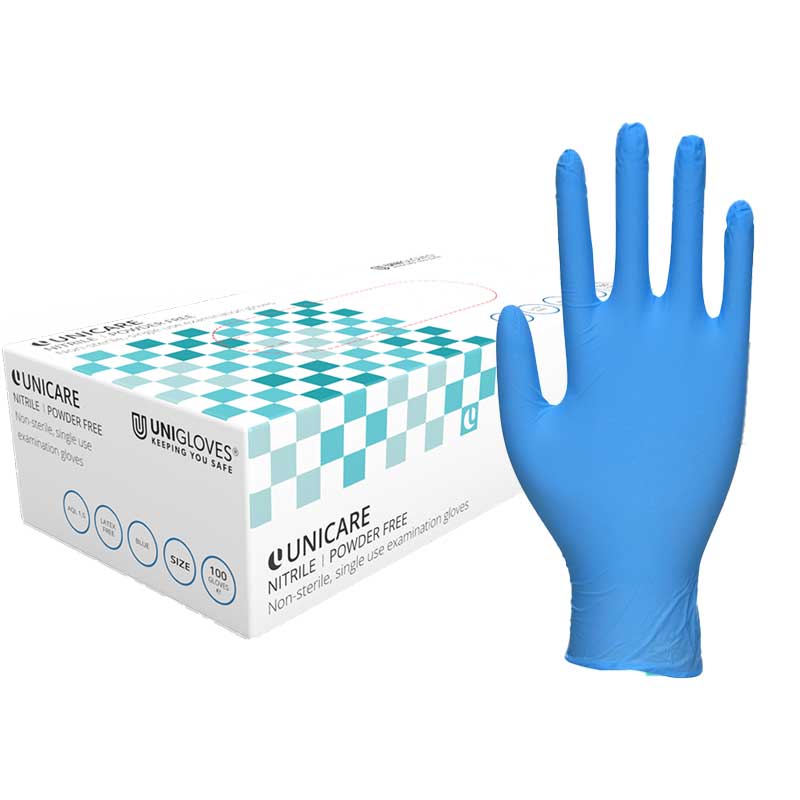
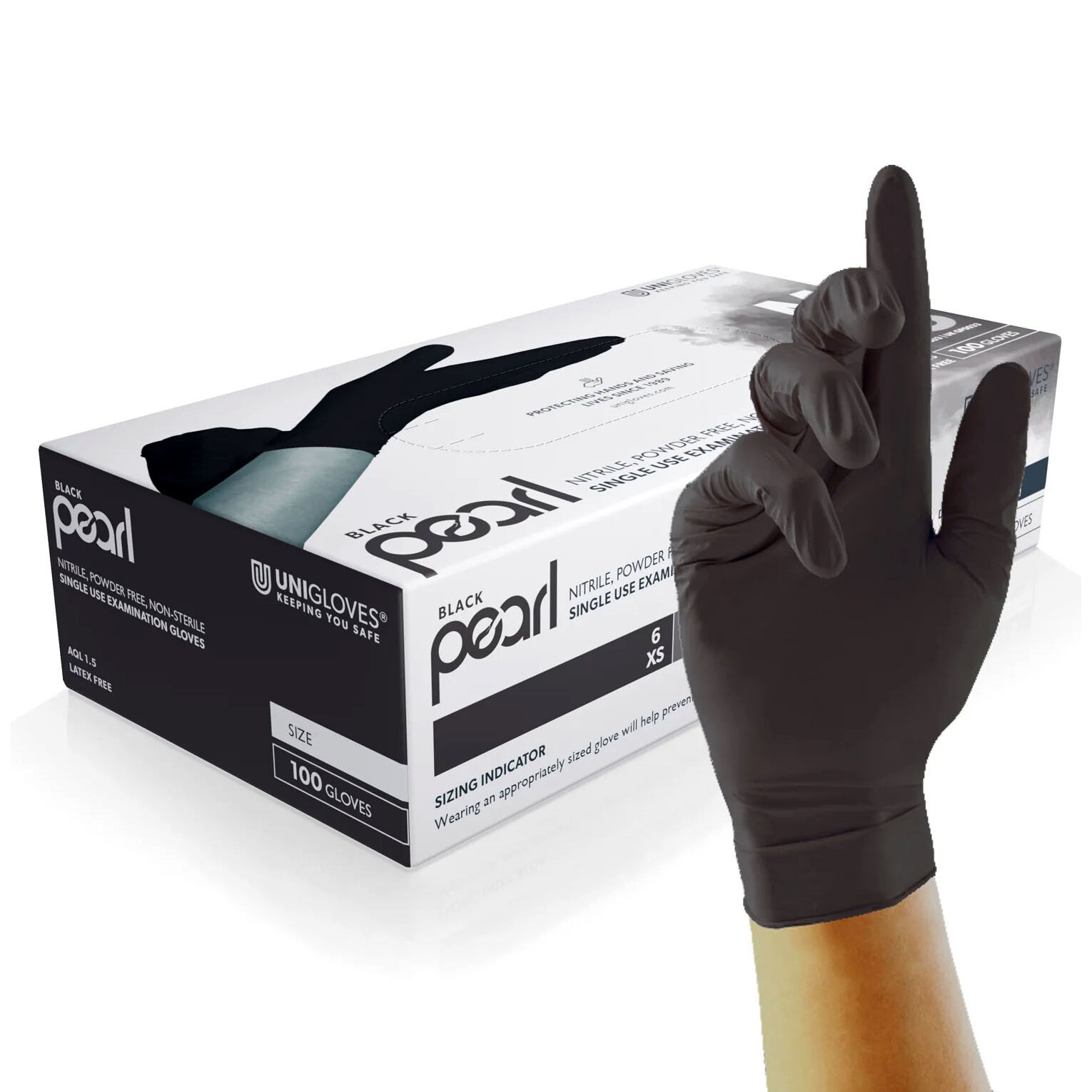
Nitrile Gloves (Box of 100)
Keep a practical supply of disposable hand protection ready for food preparation, cleaning and examination tasks. This listing offers Unigloves Unicare blue nitrile gloves in the GS003 range and Black Pearl black nitrile gloves in the GP003 range. Choose Small, Medium, Large or X-Large; each box contains 100 individual gloves.
Both ranges use powder-free synthetic nitrile with an ambidextrous shape, beaded cuff and textured fingertips. These features help with putting gloves on and handling small items. Blue Unicare gloves have a nominal fingertip thickness of 0.09mm; Black Pearl gloves have a nominal 0.10mm fingertip thickness. Both have a nominal 0.07mm palm thickness.
The manufacturer's documentation lists EN 455 parts 1–4 for medical examination gloves, EN ISO 374-1 Type C chemical protection and EN ISO 374-5 testing against bacteria, fungi and viruses. Both ranges are non-sterile, single-use gloves with AQL 1.5 freedom-from-holes testing and food-contact approval. Select from our gloves and hand protection according to the hazards and working conditions of the task.
Good glove practice includes changing gloves between activities and keeping clean supplies close to the work area. Pair them with suitable hand wash for your hand hygiene routine. These gloves contain no natural rubber latex, but they do contain accelerators that can cause allergic reactions; stop using them if irritation occurs and seek appropriate advice.
Key Features & Benefits
- Two colour ranges: blue Unicare GS003 and black Black Pearl GP003, with four selectable sizes.
- 100 individual gloves: convenient dispensing for regular glove changes.
- Textured fingertips: assist handling while the nitrile material allows finger movement.
- Either-hand fit: ambidextrous gloves with beaded cuffs.
- Documented performance: medical examination, food-contact and specified chemical and microorganism testing.
- Powder-free and latex-free: contains no natural rubber latex; not accelerator-free.
Directions for Use
1. Choose the glove for the task
Select the size and colour required, check the box identification and expiry date, and read the manufacturer's instructions. Assess the chemical, concentration, temperature and expected exposure before chemical work. Type C testing does not establish protection against every cleaning product or mixture; use the exact glove's compatibility data and your workplace risk assessment.
2. Inspect and put on
Clean and dry your hands before putting on gloves. Check for tears, holes or other defects and discard damaged gloves. Choose a fit that permits finger movement without excessive stretching or loose folds. Pull each glove on carefully at the cuff without snagging it on jewellery or sharp edges.
3. Change gloves during work
Use a fresh pair between tasks, particularly when moving from contaminated work to food or clean surfaces. Replace gloves immediately if torn, contaminated or otherwise compromised. Keep phones and shared equipment out of clean handling routines unless your hygiene procedure allows their use. Do not wash, disinfect for reuse or share disposable gloves.
4. Remove, dispose and store
Remove gloves without touching contaminated outer surfaces with bare skin, dispose of them through the appropriate waste stream and clean your hands. Keep unused boxes dry, away from direct sunlight and heat, within the manufacturer's 5–40°C storage range. Follow the printed expiry date and do not use stock with damaged packaging.
Product Specifications
| Specification |
Details |
| Pack size |
100 individual gloves per box |
| Ranges and colours |
Unicare GS003: blue; Black Pearl GP003: black |
| Sizes offered here |
Small, Medium, Large, X-Large |
| Material and finish |
Powder-free nitrile; natural rubber latex-free; textured fingertips |
| Shape and cuff |
Ambidextrous; beaded cuff; minimum length 240mm |
| Nominal thickness |
Palm: 0.07mm both ranges; fingertip: blue 0.09mm, black 0.10mm |
| Examination glove standards |
EN 455 parts 1–4; AQL 1.5 for freedom from holes |
| Protective glove standards |
EN ISO 21420; EN ISO 374-1 Type C; EN 374-2; EN ISO 374-4; EN ISO 374-5 |
| Use and classification |
Single use; non-sterile; Class I medical device and Category III PPE |
| Food contact |
Manufacturer approved for contact with all food types |
| Sensitisation information |
Contains accelerators; may cause allergic reactions |
FAQs
Does a box contain 100 gloves or 100 pairs?
Each box contains 100 individual gloves. Because the design is ambidextrous, any glove can be worn on either hand. Choose the required size and colour before adding a box to your order.
What is the difference between the blue and black options?
The blue option is Unicare GS003 and the black option is Black Pearl GP003. Both are powder-free nitrile examination gloves. Their nominal fingertip thickness differs: 0.09mm for blue and 0.10mm for black. Choose by fit, task requirements and your workplace colour system.
Are these gloves suitable for food preparation?
Unigloves approves both listed ranges for contact with all food types. Use clean gloves and change them when moving between raw ingredients, ready-to-eat food and unrelated tasks. Food-contact approval does not remove the need to follow your food hygiene procedure.
Do these gloves protect against every chemical?
No. The manufacturer reports EN ISO 374-1 testing with 40% sodium hydroxide, achieving level 6, a laboratory breakthrough time above 480 minutes. This is not a safe wear time or evidence of resistance to other chemicals. Mixtures, movement, temperature and degradation can reduce protection; check specific compatibility before use.
Are they sterile and suitable for people with allergies?
These are non-sterile examination gloves, so they are unsuitable for procedures requiring sterile gloves. They contain no natural rubber latex but do contain accelerators. Anyone sensitive to glove chemicals should check suitability, and users should stop wearing them if a reaction develops.
Can the gloves be washed and reused?
No. Both ranges are for single use. Replace them between tasks and whenever damaged or contaminated. Remove them carefully, dispose of them according to the contamination involved and clean your hands before continuing.